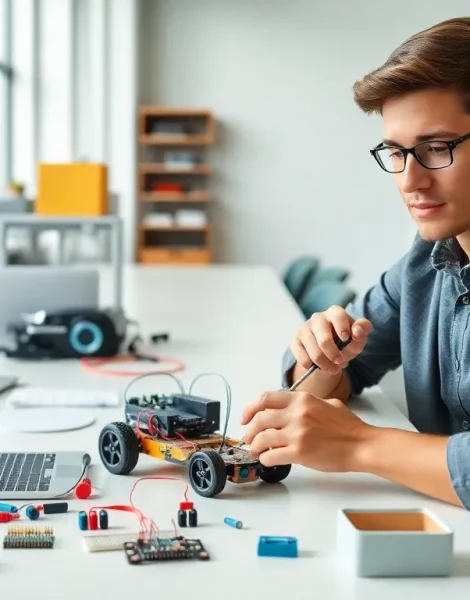
How to robotics is one of the most searched questions by curious beginners ready to build their first machine. Robotics combines engineering, programming, and creative problem-solving into a single discipline. The good news? Anyone can start learning today, no engineering degree required.
This guide breaks down the fundamentals of robotics for complete beginners. It covers the core skills to develop, project ideas to try, and resources that actually help. Whether someone wants to build a simple line-following robot or dreams of creating autonomous drones, the journey starts here.
Table of Contents
ToggleKey Takeaways
- Learning how to robotics starts with understanding three core components: sensors (eyes/ears), actuators (muscles), and controllers (brain).
- Python and C++ are the most common programming languages in robotics, with Python being ideal for beginners due to its simple syntax.
- Start with beginner-friendly projects like line-following robots or obstacle-avoiding robots using affordable Arduino kits (under $50).
- Essential skills include basic programming, electronics fundamentals, mechanical assembly, and most importantly—problem-solving through trial and error.
- Arduino and Raspberry Pi are the top hardware platforms for beginners, offering extensive tutorials and community support.
- Join makerspaces, robotics clubs, and online communities like Reddit to accelerate your learning and get help when stuck.
Understanding the Basics of Robotics
Robotics is the science of designing, building, and programming machines that can perform tasks. These machines, robots, use sensors, actuators, and controllers to interact with their environment.
What Makes a Robot?
Every robot has three core components:
- Sensors detect information from the surroundings. Examples include cameras, ultrasonic distance sensors, and temperature sensors.
- Actuators create movement. Motors, servos, and pneumatic systems fall into this category.
- Controllers process sensor data and send commands to actuators. Microcontrollers like Arduino and Raspberry Pi are popular choices for beginners.
Think of it this way: sensors are the robot’s eyes and ears, actuators are its muscles, and controllers are its brain.
Types of Robots
Robots serve different purposes across industries:
- Industrial robots handle manufacturing tasks like welding and assembly.
- Service robots assist with cleaning, delivery, or healthcare.
- Educational robots teach programming and engineering concepts.
- Hobbyist robots let enthusiasts experiment and learn.
For beginners exploring how to robotics works, educational and hobbyist robots offer the best starting point. They’re affordable, well-documented, and forgiving of mistakes.
Essential Skills You Need to Learn
Building robots requires a mix of technical skills. The good news is that none of them demand expert-level knowledge to start.
Programming
Programming tells robots what to do. Python and C++ are the most common languages in robotics. Python works great for beginners because of its simple syntax. C++ offers more control over hardware and runs faster.
Start with basic concepts:
- Variables and data types
- Loops and conditional statements
- Functions
- Reading sensor inputs
Many robotics platforms provide beginner-friendly coding environments. Arduino IDE and Scratch for robotics make learning approachable.
Electronics Fundamentals
Robots run on electricity, so understanding circuits matters. Learn these basics:
- How circuits work (voltage, current, resistance)
- Reading simple schematics
- Using breadboards for prototyping
- Connecting sensors and motors to microcontrollers
A multimeter and a few LEDs can teach more about electronics than hours of reading.
Mechanical Skills
Robots need physical structures. Basic mechanical skills help with:
- Assembling frames and chassis
- Working with common materials (plastic, aluminum, 3D-printed parts)
- Understanding gears, wheels, and motion transfer
No one expects beginners to master CAD software immediately. Simple kits often include pre-cut parts that snap or screw together.
Problem-Solving
This skill matters most. Robots rarely work perfectly on the first try. Debugging code, troubleshooting wiring issues, and iterating on designs are part of every robotics project. Embrace the process, each failure teaches something valuable.
Choosing Your First Robotics Project
The best first project matches current skill level while introducing new concepts. Here are proven options for beginners learning how to robotics.
Line-Following Robot
This classic project uses infrared sensors to detect a dark line on a light surface. The robot adjusts its motors to stay on track. It teaches:
- Sensor reading
- Motor control
- Basic logic (if sensor detects line, turn left/right)
Line-following robots can be built with Arduino kits for under $50.
Obstacle-Avoiding Robot
This robot uses ultrasonic or infrared sensors to detect objects ahead. When it senses something close, it stops or changes direction. It builds on line-following concepts and adds spatial awareness.
Remote-Controlled Robot
Building an RC robot teaches wireless communication. Beginners can use Bluetooth modules or simple RF transmitters. This project emphasizes:
- Transmitter and receiver pairing
- Real-time control systems
- Two-way communication basics
Robot Arm
A simple robot arm with 2-3 degrees of freedom introduces servo control and coordinate systems. Grabbing objects, stacking blocks, or drawing pictures are fun challenges.
Recommendations for Success
- Start with a kit before building from scratch
- Follow tutorials completely before modifying
- Document progress with notes and photos
- Join online communities for help when stuck
Tools and Resources for Learning Robotics
The right resources accelerate learning. Here’s what works for people studying how to robotics effectively.
Hardware Platforms
Arduino remains the top choice for beginners. It’s affordable, widely supported, and has thousands of tutorials. Arduino boards range from $10-30.
Raspberry Pi handles more complex projects. It runs a full operating system and supports computer vision, machine learning, and internet connectivity.
LEGO Mindstorms and VEX provide complete educational kits with motors, sensors, and building components included.
Online Learning
- Coursera and edX offer university-level robotics courses for free
- YouTube channels like “How To Mechatronics” provide step-by-step project guides
- Instructables hosts thousands of robotics projects with detailed instructions
- Reddit communities (r/robotics, r/arduino) answer questions quickly
Books Worth Reading
- Robot Building for Beginners by David Cook covers fundamentals clearly
- Make: Electronics by Charles Platt explains circuit basics hands-on
- Programming Robots with ROS introduces the Robot Operating System
Local Resources
Makerspaces and robotics clubs offer access to tools like 3D printers, laser cutters, and experienced mentors. Many cities have groups that welcome beginners. FIRST Robotics competitions inspire students of all ages.
Software Tools
- Tinkercad simulates circuits before building
- Fritzing creates wiring diagrams
- ROS (Robot Operating System) powers advanced projects
- Gazebo simulates robots in virtual environments