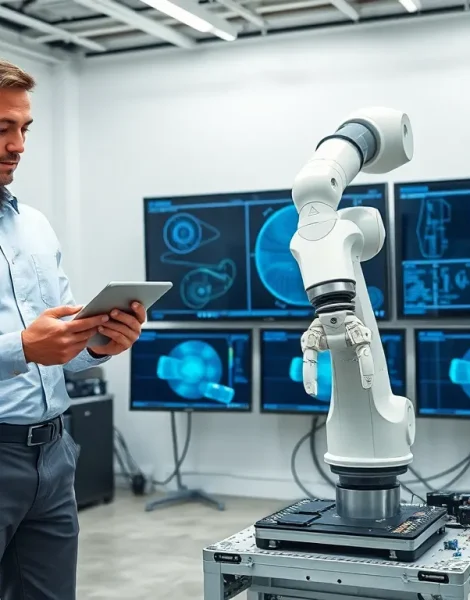
Robotics techniques form the foundation of modern automation across industries. From manufacturing floors to surgical suites, these methods enable machines to perceive, decide, and act with precision. Engineers and developers rely on a combination of motion planning, sensor integration, and machine learning to build robots that perform useful tasks.
This article breaks down the core robotics techniques driving innovation today. Readers will learn how robots move through space, process sensory data, and interact safely with humans. Each section covers practical methods that professionals use in real-world applications.
Table of Contents
ToggleKey Takeaways
- Core robotics techniques like kinematics, dynamics, and control theory form the foundation for accurate and responsive robot movement.
- Motion planning algorithms such as RRT and SLAM enable robots to navigate safely and autonomously in both structured and unknown environments.
- Sensor integration—combining cameras, LIDAR, and force sensors—gives robots the perception needed to interact effectively with their surroundings.
- Machine learning, including reinforcement and imitation learning, allows robots to acquire complex skills from data rather than explicit programming.
- Collaborative robots (cobots) use force-limiting designs and intuitive interfaces to work safely alongside humans in shared spaces.
- Following safety standards like ISO 10218 ensures reliable deployment of robotics techniques in industrial and collaborative applications.
Understanding Core Robotics Principles
Every functional robot depends on a few key principles. These include kinematics, dynamics, and control theory. Together, they allow engineers to design systems that move accurately and respond to their environment.
Kinematics describes how a robot’s joints and links produce motion. Forward kinematics calculates where the end effector (the robot’s “hand”) will be based on joint angles. Inverse kinematics works backward, it determines what joint positions are needed to reach a specific point. Industrial arms use these robotics techniques constantly when assembling products or welding parts.
Dynamics adds force and torque into the equation. A robot arm lifting a heavy object needs to account for gravity, inertia, and friction. Understanding dynamics helps engineers select motors and design controllers that won’t stall or overshoot.
Control theory ties everything together. PID controllers (proportional-integral-derivative) remain popular because they’re simple and effective. More advanced robots use model predictive control or adaptive control to handle changing conditions. These robotics techniques ensure smooth, stable movement even when loads or environments shift.
Without solid grounding in these principles, robots would be clumsy and unreliable. They form the starting point for everything else discussed here.
Motion Planning and Navigation
Motion planning answers a straightforward question: how does a robot get from point A to point B without hitting anything? The answer depends on the application.
For robotic arms in structured environments, path planning algorithms like RRT (Rapidly-exploring Random Trees) and A* search work well. RRT builds a tree of possible movements from the starting position, branching outward until it finds a collision-free path to the goal. A* uses a grid-based approach, calculating the shortest route while avoiding obstacles.
Mobile robots, think warehouse bots or delivery drones, face different challenges. They need to build maps of unknown spaces and localize themselves within those maps. SLAM (Simultaneous Localization and Mapping) handles both tasks at once. A robot using SLAM collects sensor data, identifies landmarks, and updates its position estimate in real time. This robotics technique powers autonomous vacuum cleaners and self-driving vehicles alike.
Trajectory planning goes beyond finding a path. It specifies how the robot moves along that path over time. Speed profiles matter for safety and efficiency. A collaborative robot working near humans might slow down when someone approaches, then speed up once the area clears.
These robotics techniques continue to improve. Researchers are developing planners that adapt on the fly, recalculating routes when obstacles move unexpectedly.
Sensor Integration and Perception
Robots need to sense the world before they can act on it. Sensor integration combines data from multiple sources to create a coherent picture of the environment.
Cameras provide rich visual information. Stereo cameras capture depth by comparing two images, similar to human binocular vision. RGB-D cameras (like the Intel RealSense series) combine color images with depth data directly. Computer vision algorithms process these feeds to detect objects, read barcodes, or recognize faces.
LIDAR (Light Detection and Ranging) measures distances using laser pulses. It produces detailed 3D point clouds that robots use for mapping and obstacle detection. Autonomous vehicles rely heavily on LIDAR because it works well at range and isn’t fooled by shadows or lighting changes.
Force and torque sensors give robots a sense of touch. When a robot arm inserts a component into an assembly, force feedback prevents it from jamming or breaking parts. These sensors enable robotics techniques like compliant control, where the robot “feels” its way through a task.
Sensor fusion merges data from different sensor types. A mobile robot might combine wheel encoders (which track rotation), an IMU (inertial measurement unit), and GPS for accurate positioning. Kalman filters and particle filters handle the math, weighing each sensor’s reliability and producing a best estimate.
Good perception is half the battle. Without accurate sensing, even the best motion planners will fail.
Machine Learning in Robotics
Machine learning has transformed what robots can do. Instead of programming every behavior explicitly, developers train models on data and let robots learn from experience.
Supervised learning works when labeled examples exist. A robot learning to sort objects might train on thousands of images tagged with category labels. After training, it generalizes to new objects it hasn’t seen before. This approach powers visual inspection systems in manufacturing.
Reinforcement learning (RL) takes a different route. The robot tries actions, receives rewards or penalties, and gradually improves. RL has taught robots to walk, manipulate objects, and even play games. DeepMind’s work on robotic manipulation shows how RL can solve tasks that are hard to program manually.
Imitation learning lets robots learn by watching humans. A person demonstrates a task, say, folding laundry, and the robot learns to replicate the motion. This robotics technique speeds up deployment because it skips the need for complex reward design.
Neural networks underpin most modern approaches. Convolutional neural networks (CNNs) excel at image processing. Recurrent networks handle sequential data. Transformer architectures are beginning to appear in robotics research too.
These robotics techniques require significant compute power and data. But they enable capabilities that traditional programming simply can’t match.
Human-Robot Interaction Techniques
As robots move out of cages and into shared spaces, safe interaction with humans becomes critical. Human-robot interaction (HRI) covers everything from physical safety to intuitive communication.
Collaborative robots (cobots) are designed to work alongside people. They use force-limiting joints and rounded edges to minimize injury risk. If a cobot contacts a person unexpectedly, it stops immediately. Companies like Universal Robots and FANUC have built entire product lines around these robotics techniques.
Speech and gesture recognition make robots easier to command. Voice interfaces let workers issue instructions without touching a screen. Gesture recognition allows a quick wave to pause or redirect a robot. Natural language processing models are getting better at understanding context and intent.
Shared autonomy blends human judgment with robot capability. A surgeon might guide a robotic arm during a procedure while the robot steadies the motion and filters out hand tremors. The human stays in control, but the robot adds precision.
Safety standards shape how these systems are deployed. ISO 10218 and ISO/TS 15066 specify requirements for industrial robots and collaborative applications. Following these standards protects workers and limits liability.
Good HRI design considers psychology as well as engineering. People need to trust robots before they’ll work effectively with them. Clear feedback, predictable behavior, and appropriate speed all build that trust over time.